From the rigid historic soils of the French Quarter to the young, soft alluvium in New Orleans East, the ground beneath this city changes drastically in just a few miles. A levee setback in Lakeview deals with highly plastic clays, while an excavation near the Industrial Canal hits loose silty sands with a water table at four feet. These contrasts define why slope stability analysis cannot be a generic exercise here. Our team evaluates each cut, embankment, or natural slope by integrating pore pressure data from the local aquifer system with standard penetration testing to characterize the stratigraphy. We model the complex interaction between the Mississippi River’s annual stage fluctuations and the underlying compressible clay layers, delivering a factor of safety that reflects real operational conditions and not just textbook assumptions.
A slope in New Orleans rarely fails from a single cause; it is the combination of a rising river stage, a delayed pore pressure response, and a thin weak seam of organic clay that triggers the movement.
Methodology applied in New Orleans
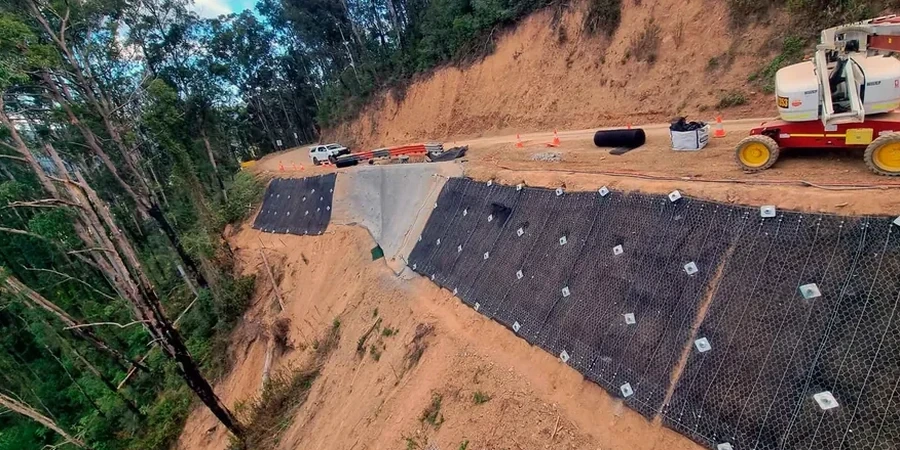
Typical technical challenges in New Orleans
A 40-foot excavation near the Central Business District was advancing on schedule until a piezometer in the adjacent lot showed a 6-foot head rise after a heavy summer storm. The contractor had not cut the slope back to the design angle, trusting the stiff crust to stand unsupported. Within hours, tension cracks appeared 15 feet behind the soldier pile wall, and the sidewalk began to settle. Our team mobilized immediately to install additional relief wells and recalculate the short-term stability using undrained shear strengths from field vane tests in the underlying fat clay. The situation was stabilized, but it reinforced a costly lesson: in New Orleans, suction-driven strength in the desiccated crust disappears faster than most engineers anticipate, and a slope that looks stable on a dry Tuesday can be at the brink of failure by Friday afternoon.
Our services
Our approach to slope stability in the New Orleans Metro area covers the full project lifecycle, from pre-design investigation through construction monitoring. Each service is adapted to the local geomorphology of the Mississippi River delta.
Levee and Floodwall Stability
Evaluation of existing and proposed levee sections under rapid drawdown and storm surge loading, using USACE design criteria and site-specific pore pressure distributions.
Deep Excavation Support Analysis
Stability of temporary cuts and braced excavations in soft clays, including base heave assessment and the influence of nearby structures on the failure wedge.
Natural Slope and Bluff Assessment
Long-term monitoring and back-analysis of riverbank failures along the Mississippi and its distributaries, incorporating erosion rates and fluctuating river stages.
Seismic Deformation Analysis
Newmark-type sliding block analysis for slopes in Site Class E and F soils, quantifying permanent displacement under the design earthquake per ASCE 7 requirements.
Questions and answers
What is the typical cost for a slope stability analysis in New Orleans?
The fee for a comprehensive analysis generally ranges from US$1,260 to US$4,090, depending on the slope height, the complexity of the stratigraphy, and whether instrumentation data is already available. Projects requiring finite element modeling or seismic deformation analysis fall toward the upper end of that range.
Why is rapid drawdown the controlling condition for many New Orleans slopes?
Because the river stages can drop quickly after a flood peak, while the low-permeability backswamp clays retain high pore pressures. This creates an unbalanced seepage force that reduces the effective stress and can trigger a failure on the waterside slope before the excess pressure has time to dissipate.
How do you account for the organic layers found under the Metro area in the analysis?
We identify the peat and highly organic clays through continuous sampling and laboratory testing, then assign them very low effective friction angles and a high compressibility. In the stability model, these layers often form the basal failure plane, so we refine the search algorithm to force a non-circular slip surface that tracks along the organic seam.