A contractor recently brought us samples from a Mid-City project where the foundation excavation kept filling with gray, sticky clay that wouldn't drain. The crew had already swapped pumps twice. In the lab, the liquid limit on that material came back at 78 — extremely high plasticity, typical of the fat clays deposited across New Orleans by millennia of Mississippi River flooding. Atterberg limits testing is the most direct way to quantify how a fine-grained soil will behave when it gets wet, which in this city is not a hypothetical scenario. The test gives us three numbers: liquid limit, plastic limit, and the plasticity index that separates a workable silt from a problematic clay. For geotechnical engineers working in the Gulf Coast alluvium, these values are not just classification data — they are early warnings about settlement, heave, and long-term stability under the fluctuating water table that defines construction in New Orleans. Combining these results with a grain-size analysis gives us a complete picture of the soil's texture and its likely response to moisture changes.
A plasticity index above 30 in New Orleans alluvium is a reliable predictor of shrink-swell cycles that can crack slabs within two seasonal transitions.
Methodology applied in New Orleans
Typical technical challenges in New Orleans
The most common mistake we see from contractors working in New Orleans East or the Lower Ninth Ward is assuming that a soil boring log with a simple 'clay' description is enough to proceed with foundation design. It is not. Two clays with identical visual appearance can have liquid limits 40 points apart, and the one with the higher plasticity index will lose bearing capacity dramatically as moisture increases during the June-to-October rainy season. We have reviewed projects where slabs on grade were poured over CH clays with PI values above 45 without any moisture conditioning plan, and the resulting differential heave cracked the slab before interior framing was complete. The Atterberg limits test costs a fraction of that repair. In the alluvial and lacustrine deposits that define New Orleans geology, skipping this lab work means designing blind to the soil's most sensitive mechanical property. For deep excavations near the river, we pair Atterberg data with deep-excavations monitoring plans to anticipate bottom heave and wall instability.
Our services
Our New Orleans soil laboratory provides Atterberg limits as a standalone classification service and as part of comprehensive geotechnical testing programs. All testing is performed on representative samples obtained from site investigation — we coordinate directly with drilling crews operating across Orleans, Jefferson, and St. Bernard parishes to minimize turnaround time.
Multipoint Liquid Limit (Casagrande Method)
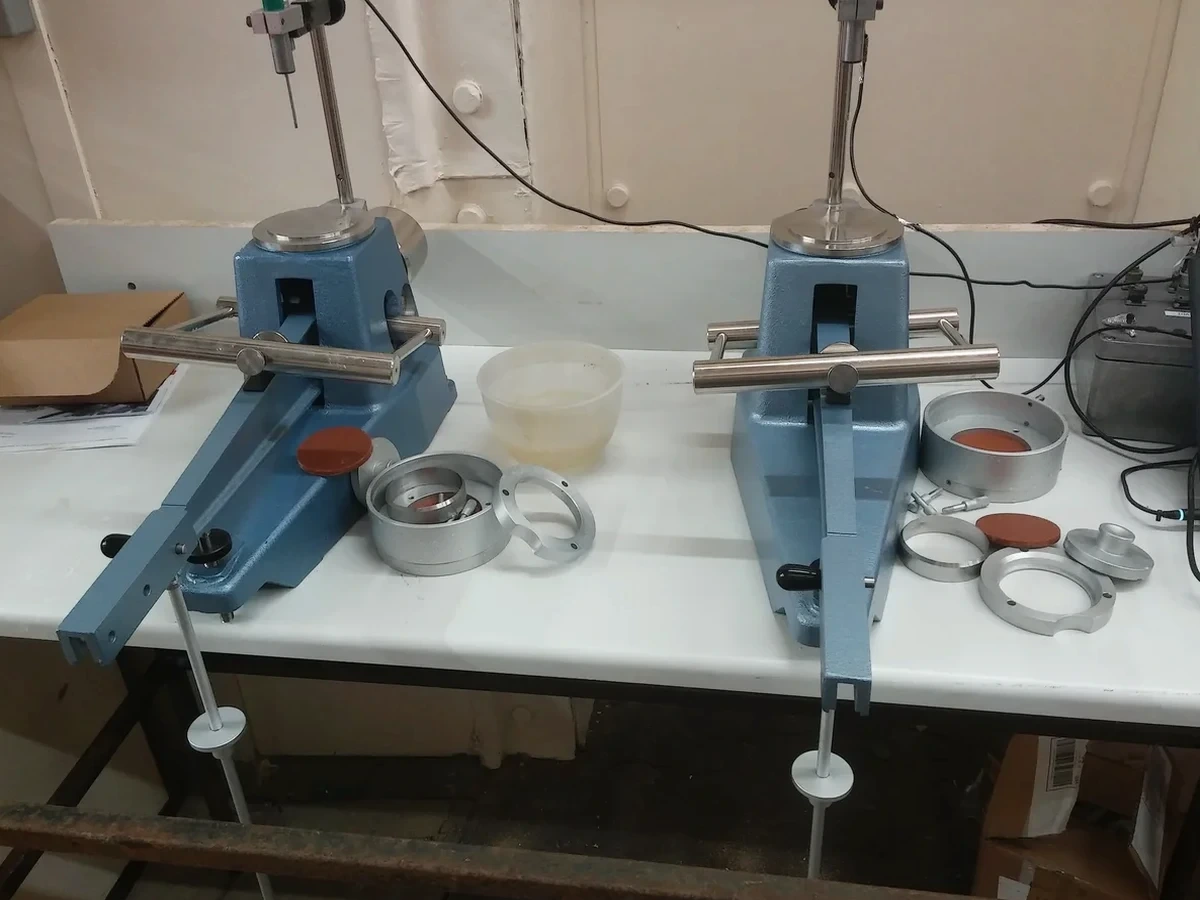
Full ASTM D4318 multipoint determination with minimum three moisture contents, automated blow counter, and calibrated grooving tools. Results include flow curve, liquid limit, and one-point verification for quality control.
Plastic Limit and Plasticity Index
Hand-rolled plastic limit determination by experienced technicians followed by plasticity index calculation. Includes USCS group symbol assignment per ASTM D2487 and shrink-swell potential screening based on PI and clay fraction activity.
Atterberg Limits with Soil Moisture Profile
Paired testing of natural moisture content (ASTM D2216) alongside Atterberg limits to compute liquidity index and assess in-situ consistency. Recommended for New Orleans sites where groundwater is within 1.5 m of grade.
Questions and answers
What does the Atterberg limits test actually measure, and why does it matter for a New Orleans building site?
The test measures two critical moisture thresholds: the liquid limit — the water content at which a clay soil starts behaving like a viscous liquid — and the plastic limit, below which the soil crumbles rather than deforms plastically. The difference between them is the plasticity index. For New Orleans, where the water table sits high and precipitation averages over 1,500 mm annually, the plasticity index tells us how much a soil's volume and strength will change as it cycles between wet and dry conditions. A high-PI fat clay from the Gentilly area can swell enough to lift a lightly loaded slab by several centimeters.
How much does Atterberg limits testing cost in New Orleans?
Atterberg limits testing typically runs between US$50 and US$100 per sample for the full liquid limit, plastic limit, and plasticity index determination. The exact cost depends on the number of samples and whether we are running one-point or multipoint liquid limits. For projects requiring rush turnaround, we can often deliver results within 48 hours.
Can you run Atterberg limits on sandy soils from the riverfront or Lake Pontchartrain?
Atterberg limits are defined only for the fine fraction of soil — material passing the #40 (425 µm) sieve. Sandy soils with less than about 15 percent fines generally do not exhibit plasticity and the test is not applicable. For those materials, we recommend a grain-size sieve analysis instead to characterize the sand and gravel fractions. If the sample contains some fines but also significant sand, we wet-sieve it first and run Atterberg limits only on the minus-40 fraction.
How long does it take to get Atterberg limits results from your lab?
Standard turnaround is three to five business days from sample receipt. The multipoint liquid limit requires oven-drying and careful re-mixing at multiple moisture contents, which cannot be rushed without compromising the flow curve. For time-sensitive projects in New Orleans, we offer a 48-hour expedited service. Samples with high organic content from swamp deposits may require additional drying time.
Is the Atterberg limits test enough to classify a soil for foundation design, or do I need other tests?
Atterberg limits provide the plasticity classification and, combined with grain-size data, the full USCS group symbol — but they do not measure strength or compressibility directly. For foundation design in New Orleans' soft alluvial clays, we typically recommend supplementing Atterberg data with spt-drilling to obtain SPT N-values for bearing capacity estimates, and consolidation testing if the plasticity index and natural moisture content suggest the soil is normally consolidated and settlement-sensitive.