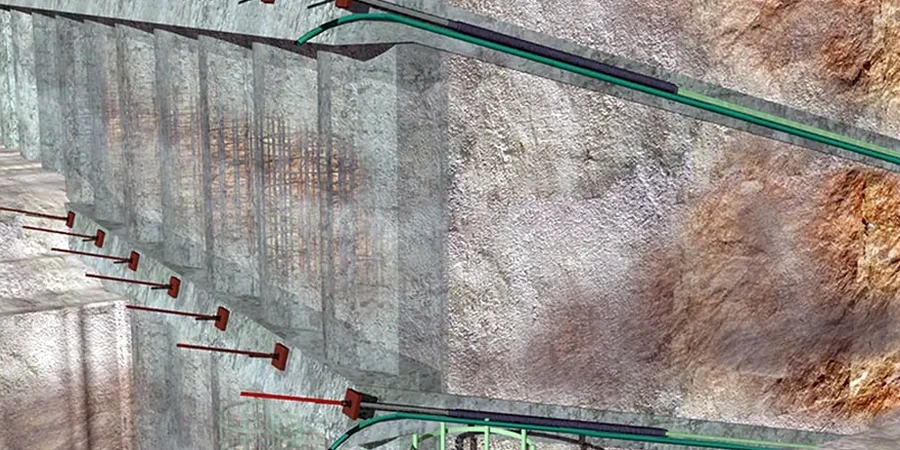
New Orleans grew outward from a natural levee on the Mississippi River, a city built on soft deltaic deposits where every deep excavation fights groundwater intrusion. The expansion of drainage canals and flood protection systems through the 20th century forced engineers to confront difficult retention problems in compressible clays and loose silts. Tieback anchors became a practical solution for these conditions, transferring load beyond the failure plane into more competent strata. Our design work addresses the specific challenge of developing bond length in soils where the CPT test often controls the stratigraphic profile, confirming tip resistance and sleeve friction before any anchor bond zone is defined. Active anchors prestress the tendon to limit movement, while passive anchors mobilize resistance only when the wall displaces. Both approaches have their place in the New Orleans subsurface, where the margin between a dry excavation and a flooded site can be a few feet of head difference. We deliver anchor designs that account for corrosion protection in the aggressive, sulfate-rich environment typical of the Gulf Coast.
In the New Orleans subsurface, an anchor is only as reliable as the clay it bonds to — that is why we size the grout-to-ground interface for the residual shear strength, not the peak.
Methodology applied in New Orleans
Live process video
Typical technical challenges in New Orleans
New Orleans sits at elevations ranging from -6.5 to +20 feet NAVD88, and much of the city relies on pump stations to stay dry. A retained excavation that loses anchor capacity during a hurricane storm surge can flood in minutes, not hours. The risk compound when anchors are installed in the organic clays of the former backswamp areas, where the undrained shear strength can drop below 400 psf. Creep rupture is a documented failure mode in these soils: the anchor gradually pulls out without any obvious warning sign. We mitigate this by limiting the design bond stress to a fraction of the residual strength, and by requiring lift-off tests on a percentage of production anchors. Settlement of the anchor wall itself is another risk. In New Orleans, the fill behind a sheet pile wall compresses under its own weight, dragging the anchor down and increasing the bending moment in the wall. Our design accounts for this downdrag effect with a staged loading analysis, checking the anchor inclination and the vertical component of load against the bearing capacity of the wall.
Our services
Our anchor design services for New Orleans projects cover the full chain from site investigation to construction support. The soft soil conditions demand a conservative design philosophy backed by field verification.
Anchor load test specifications
We write performance and proof test procedures adapted to the high groundwater and low-strength clays of the Mississippi delta. Every specification includes pass/fail creep criteria and lock-off procedures.
Corrosion protection detailing
Permanent anchors in New Orleans require Class I protection. We detail the sheathing, grout cover, and end anchorage to meet the 75-year design life required by the USACE for flood protection works.
Wall-anchor interaction analysis
Using beam-on-elastic-foundation methods, we model the sequential excavation and anchor stressing stages, checking wall deflection and bending moment against the allowable limits for adjacent structures.
Residual load monitoring plans
We design monitoring programs using load cells on selected anchors, tracking the relaxation behavior of the clay over the first 12 months after lock-off and comparing it to the design assumptions.
Questions and answers
What is the difference between an active anchor and a passive anchor?
An active anchor is tensioned during installation, applying a predetermined force to the retaining structure before any soil movement occurs. This preload controls wall deflection from the start. A passive anchor is not prestressed; it only develops resistance once the wall moves enough to stretch the tendon. In New Orleans, we typically specify active anchors for permanent floodwalls and deep excavations near sensitive structures, where movement must be kept under half an inch. Passive anchors are more common for temporary sheet pile walls in open areas, where some deflection is acceptable and the installation cost needs to stay lower.
What anchor capacity can be achieved in New Orleans clays?
The achievable capacity depends entirely on the undrained shear strength of the clay at the bond zone depth. In the upper 30 feet, where Su often ranges from 300 to 800 psf, we typically design for 15 to 35 kips per anchor. Deeper bond zones that encounter Pleistocene terrace deposits or sand lenses can reach 80 to 200 kips. Every design is validated by a site-specific CPT or pressuremeter test to confirm the stratigraphy and strength profile before the bond length is finalized.
How much does anchor design and testing cost for a New Orleans project?
The engineering design and construction support for an anchored wall system in the New Orleans area generally falls in the range of US$980 to US$4,180, depending on the number of anchor rows, the complexity of the corrosion protection requirements, and the extent of load testing specified. A simple temporary excavation with one row of anchors will be at the lower end of that range. A permanent floodwall with multiple anchor levels, Class I corrosion protection, and a full proof-testing program on every anchor will approach the upper end.