You can't look at a site in New Orleans and assume the ground will behave like it does in Baton Rouge. Decades of river sediment, organic silts, and historic fill have created a subsurface profile that demands a specific kind of intervention. When we design a vibrocompaction program here, the first thing we assess isn't the structure—it's the depth and consistency of the hydraulic fill that underlies so much of the city. A standard test pits investigation often reveals those soft, loose layers that continuous sampling might miss, especially near the Industrial Canal where backfill practices have varied wildly over the last century. We pair that with CPT testing to get a continuous profile of tip resistance, which tells us precisely where the vibroflot needs to work. The goal isn't just to hit a generic N-value; it's to design a grid that accounts for New Orleans' high water table and the risk of post-densification re-saturation, ensuring the improved ground can handle both the static loads of a slab-on-grade and the dynamic demands of a hurricane wind event.
In New Orleans, effective vibrocompaction design isn't about maximum penetration depth; it's about achieving uniform densification below the critical saturation zone.
Methodology applied in New Orleans
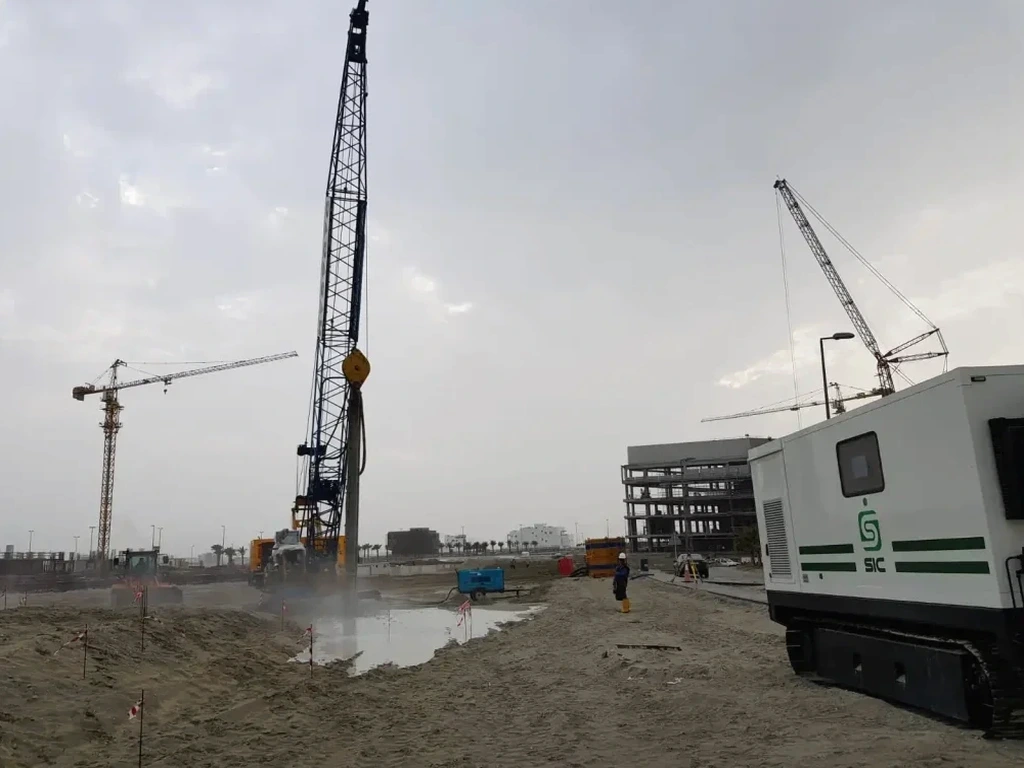
Typical technical challenges in New Orleans
A dry season in New Orleans can be deceiving. The groundwater table here doesn't just sit a few feet down—it fluctuates with the river stage and can rise to within inches of the surface after a heavy storm surge. Designing a vibrocompaction program without accounting for this means you're essentially compacting in a submerged condition half the time, which changes the effective stress and the probe's amperage response. The real danger is leaving untreated lenses below the seasonal low-water mark; these can collapse later, causing differential settlement that cracks slabs and shears utility lines. That's why we specify pre-wetting in some zones and strictly control the water injection rate during compaction, making sure the soil skeleton is being rearranged, not just temporarily supported by pore pressure. Ignoring the interaction between the Mississippi's hydrology and your building pad is how you end up with a floor that tilts toward the street five years after the certificate of occupancy is signed.
Our services
We deliver a complete vibrocompaction design package that goes beyond just marking a grid on a plan. Each phase is built around the specific subsurface conditions we’ve mapped for your part of New Orleans.
Pre-Design Soil Profiling
We analyze existing borings and supplement with targeted in-situ tests to map the loose zones that will govern your compaction grid design.
Vibroflot Grid Optimization
Using energy-based models, we determine the ideal spacing and probe sequence to achieve uniform density without over-compacting sensitive clays.
Performance Specification Writing
We prepare the technical specs—including acceptance criteria based on post-treatment CPT verification—so your contractor bids on a level playing field.
Construction Phase Verification
During the vibro work, we monitor real-time amperage and lift records, adjusting the design parameters as needed to match the actual ground response.
Questions and answers
What does a vibrocompaction design package cost for a typical New Orleans commercial lot?
For a standard commercial footprint in the New Orleans area, a complete design package—including review of existing geotechnical data, development of the compaction grid, and performance specifications—typically ranges from US$1,640 to US$5,600. The final cost depends on the complexity of the soil profile and the extent of pre-design testing required.
How deep can vibrocompaction effectively treat the loose sands we see in the New Orleans metro area?
In the alluvial deposits common around New Orleans, we can effectively treat loose sands down to about 35 feet using standard hanging-lead vibroflots. Deeper treatments are possible but require extended probe sections and a careful analysis of the underlying clay strata to ensure the energy isn't being wasted compressing a material that won't densify.
How do you verify that the compaction met the design target before we start pouring foundations?
Verification is done through post-treatment CPT soundings right through the center of the compaction grid. We compare the pre- and post-treatment tip resistance and sleeve friction to confirm the target relative density was achieved. In some cases, we also run a limited number of SPT tests to correlate with the CPT data for the structural engineer's records.