New Orleans sits on some of the most challenging ground in the United States: recent Holocene alluvium, peats, and soft clays deposited by the Mississippi River, with groundwater often just three to five feet below street level. When tunneling through this kind of profile—think the thick, compressible clays that run under the Central Business District—you are not dealing with rock mechanics. You are managing a saturated, underconsolidated mass that deforms almost as soon as you excavate. In our experience, a reliable geotechnical analysis for soft soil tunnels here starts with high-quality sampling and laboratory strength testing, then feeds directly into face stability calculations and settlement trough predictions. Before fieldwork begins, we often pair deep borings with a CPT test to get a continuous read on undrained shear strength without the disturbance that sampling these sensitive clays can cause. This information defines the construction method, the need for compensation grouting, and the real extent of ground movement expected under Magazine Street or alongside the historic St. Charles Avenue streetcar line. The goal is not just to design a lining—it is to protect the infrastructure above without surprises.
In New Orleans, the soil tells you the tunnel alignment—you do not impose a design on ground that can lose 30 percent of its strength upon remolding.
Methodology applied in New Orleans
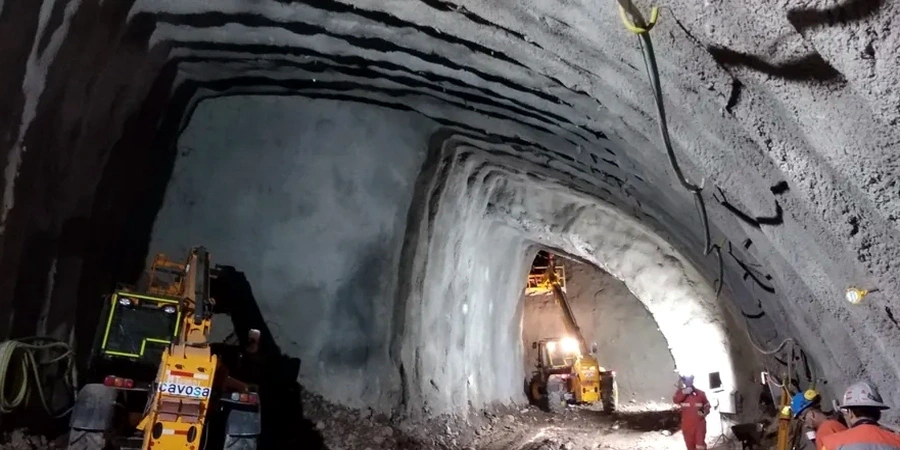
Typical technical challenges in New Orleans
The high humidity and relentless summer rainfall of south Louisiana do more than complicate construction logistics—they keep the soil mass fully saturated year-round, eliminating any benefit from apparent cohesion in silty layers. This means that a tunnel face in New Orleans clay can squeeze and fail inward within hours if advance rates are too slow or if the face support pressure drops below the in-situ earth pressure. What we see most often in this region is not catastrophic collapse but progressive volume loss: the ground moves toward the excavation, surface settlement troughs widen, and adjacent shallow foundations—many of them on timber piles dating back a century—begin to rotate. A proper analysis must define the limiting support pressure curve along the tunnel alignment, segment by segment, accounting for variations in stratigraphy and the proximity of existing utilities. Ignoring the consolidation settlement that follows excavation, even months after ring installation, is a mistake that can put cast-iron water mains and fragile historic structures at risk.
Our services
Our tunnel geotechnical work in New Orleans covers the full analysis and monitoring chain, from initial site investigation through construction-phase instrumentation:
Tunnel Face Stability and Settlement Analysis
We model undrained and drained behavior under the specific stratigraphy of the New Orleans deltaic plain, delivering support pressure curves and transverse settlement trough predictions that account for the high sensitivity of local clays.
Laboratory Testing for Soft Clays
Consolidated-undrained triaxial with pore pressure measurement, one-dimensional consolidation, and Atterberg limits under ASTM standards, all run on undisturbed Shelby tube samples extracted below the water table.
Construction-Phase Monitoring Integration
We link the geotechnical baseline report with real-time surface settlement arrays, inclinometers, and piezometers, allowing the contractor to adjust face pressure and advance rate based on measured ground response.
Questions and answers
What makes soft soil tunneling in New Orleans different from other U.S. cities?
The combination of very soft, normally consolidated clays with high sensitivity and a groundwater table just a few feet below grade is unusual. In New Orleans you are tunneling through recent deltaic deposits that have not been preconsolidated by glacial loading, so they compress and deform under very small stress changes. This demands a detailed consolidation analysis and careful control of face pressure that would be less critical in stiffer, overconsolidated clays found in northern cities.
How do you determine the appropriate support pressure for a tunnel face in these soils?
We combine CPT pore pressure dissipation data with consolidated-undrained triaxial results to build an effective stress model along the alignment. Using limit equilibrium methods and, for complex geometries, finite element analysis, we define the minimum face pressure that prevents collapse and limits volume loss to acceptable levels—typically under two percent for urban tunnels with sensitive surface structures.
What is the typical cost range for a geotechnical analysis of a soft soil tunnel project in New Orleans?
Depending on the tunnel length, depth, and the density of borings and laboratory tests required, a comprehensive analysis for a soft soil tunnel in New Orleans typically ranges from US$4,200 to US$17,830. This covers field investigation planning, advanced laboratory testing, stability and settlement analyses, and the geotechnical baseline report.
How do you account for the long-term settlement of the tunnel after construction?
We run one-dimensional consolidation tests on undisturbed samples from below the tunnel invert to obtain the compression index and coefficient of consolidation. These parameters feed into time-dependent settlement models that estimate how much the tunnel will sink over 30-plus years due to dissipation of excess pore pressures generated during excavation. We also factor in secondary compression for the peat layers occasionally encountered at depth.