The geotechnical contrast between New Orleans' historic riverfront and the reclaimed areas of New Orleans East dictates fundamentally different foundation strategies. Along the Mississippi River, Pleistocene terrace deposits offer relatively competent bearing strata, but just a few miles north, the soil profile transitions into thick sequences of normally consolidated clay interspersed with peat and organic silt. When a project site straddles these boundaries, standard penetration resistance values alone cannot resolve the undrained shear strength discrepancy needed for deep foundation analysis. We run consolidated-undrained triaxial tests with pore pressure measurement to isolate the effective stress parameters that control long-term settlement in these compressible deposits. For projects near the Industrial Canal, where fill layers mask the natural stratigraphy, our lab often pairs the triaxial program with a detailed grain size analysis to correlate fines content with the measured friction angle, ensuring the design parameters reflect actual depositional history rather than generic correlations.
A well-executed triaxial program on soft New Orleans clay reveals the effective stress friction angle that governs long-term stability, a parameter SPT blow counts cannot estimate.
Methodology applied in New Orleans
Typical technical challenges in New Orleans
The post-Katrina reconstruction boom accelerated development across New Orleans' flood-prone basins, yet the underlying geology remains unchanged: interbedded soft clays and organic silts deposited by the Mississippi River's historic meandering. The most consequential geotechnical failure mode here is not bearing capacity rupture, but progressive undrained creep beneath wide embankments and mat foundations, a phenomenon documented by the USACE after levee distress during the 2005 flood event. When a triaxial program is omitted or replaced with unconfined compression alone, engineers lose the effective stress envelope that predicts whether a normally consolidated clay will generate positive or negative excess pore pressure under load. A site in New Orleans East with a 60-foot-thick Layer 2 clay profile can experience shear strain accumulation at deviator stresses well below the peak strength measured in a quick undrained test. Our laboratory protocol addresses this by running multiple specimens at confining pressures bracketing the in-situ vertical effective stress, constructing a Mohr-Coulomb failure envelope that explicitly defines the drained friction angle for use in coupled consolidation analyses. For critical infrastructure near the London Avenue Canal, we also evaluate the sensitivity of the clay, because a strain-softening response—where remolded strength drops below 30% of the peak—requires a different safety margin than a ductile material. This concern extends to liquefaction assessments in the sandy point-bar deposits found beneath the French Quarter, where cyclic triaxial testing quantifies the pore pressure generation curve that simplified SPT-based methods miss.
Our services
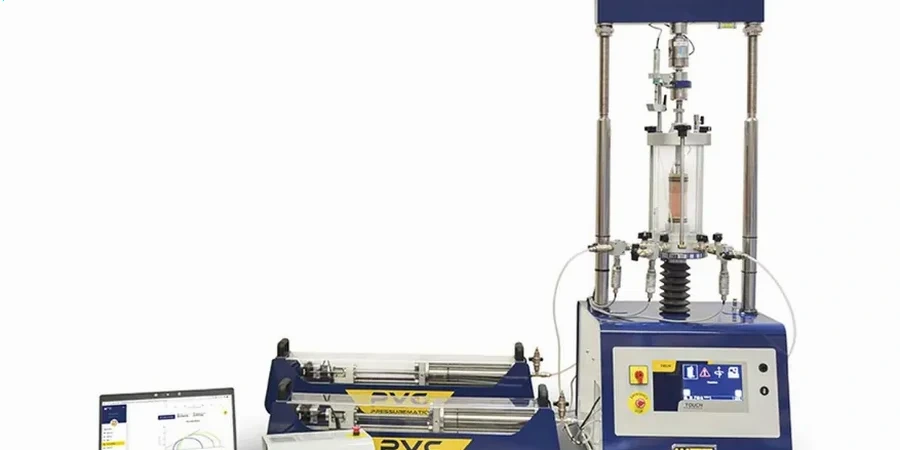
Our triaxial testing program in New Orleans covers the full range of shear strength characterization needed for foundation design, slope stability, and earth retention in the region's challenging soft soils:
Consolidated-Undrained (CU) with Pore Pressure
The standard for soft New Orleans clays. We saturate to B≥0.95, consolidate isotropically to in-situ stress, and shear at 0.05%/min while recording excess pore pressure. Results deliver c' and φ' for effective stress analysis of embankments on the Lake Pontchartrain shoreline.
Consolidated-Drained (CD) for Granular Soils
For the Pleistocene sands encountered in Uptown borings, we run drained tests at 0.01%/min to prevent pore pressure buildup. The measured φ' directly feeds the bearing capacity calculations for shallow footings where the water table sits at 4 feet below grade.
Unconsolidated-Undrained (UU) Quick Shear
Applied to cohesive samples where rapid loading conditions govern, such as temporary excavation support in the compressible clays of Mid-City. We follow ASTM D2850 and report total stress parameters Su and φ=0 for short-term stability checks before the soil has time to drain.
Questions and answers
What is the cost range for a triaxial test program in New Orleans?
A standard set of three CU triaxial tests with pore pressure measurement on undisturbed Shelby tube samples typically ranges from US$2,110 to US$2,480, depending on the number of confining stress points and the reporting requirements for the project.
When do I need a CU test instead of a simple unconfined compression test?
Unconfined compression (UC) gives a quick undrained strength but cannot separate cohesion from friction. In New Orleans' soft clays, where effective stress governs settlement and slope stability, a CU test is necessary whenever your design requires c' and φ' parameters. This applies to all permanent structures, levees, and any excavation deeper than 10 feet in compressible ground.
How do you handle sample disturbance in New Orleans soft clays?
Sample disturbance is a major concern in the city's sensitive clays. We evaluate disturbance using the ratio of undrained shear strength from triaxial to that from field vane, and we apply the SHANSEP correction when the preconsolidation pressure from oedometer tests indicates a structured soil. Specimens are trimmed only from the center of the Shelby tube, and we reject any sample with visible cracks, sand lenses, or organic inclusions that would compromise membrane integrity during saturation.
What strain rate do you use for triaxial tests on New Orleans soils?
For CU tests on fine-grained soils per ASTM D4767, we calculate the strain rate from the consolidation phase by determining t100 from the volume change curve. The axial strain rate is set to achieve failure within approximately 8 to 12 hours, which for typical New Orleans clays falls between 0.03% and 0.07% per minute. For drained tests on sands, we use 0.01% per minute to prevent any excess pore pressure accumulation.