A common mistake we see in New Orleans is treating seismic design as an afterthought, particularly for structures on the city’s compressible alluvial clays. The misconception that the Gulf Coast is seismically inactive leads to designs that overlook the long-period ground motion amplification these soft soils can produce. When a project demands operational continuity after an event — a hospital, a data center, or emergency response facility — conventional fixed-base design falls short. Our approach integrates seismic microzonation data specific to the Mississippi River delta to define the design basis, moving directly into a tailored base isolation system. We don't just apply a generic isolator; we model the structure-soil-isolator interaction using site-specific CPT test results that capture the precise stratigraphy of the New Orleans basin, ensuring the isolation period avoids resonance with the site’s fundamental frequency.
In New Orleans, effective base isolation isn't just about selecting an isolator; it's about modeling the nonlinear behavior of the underlying soft clays during a seismic event.
Methodology applied in New Orleans
Typical technical challenges in New Orleans
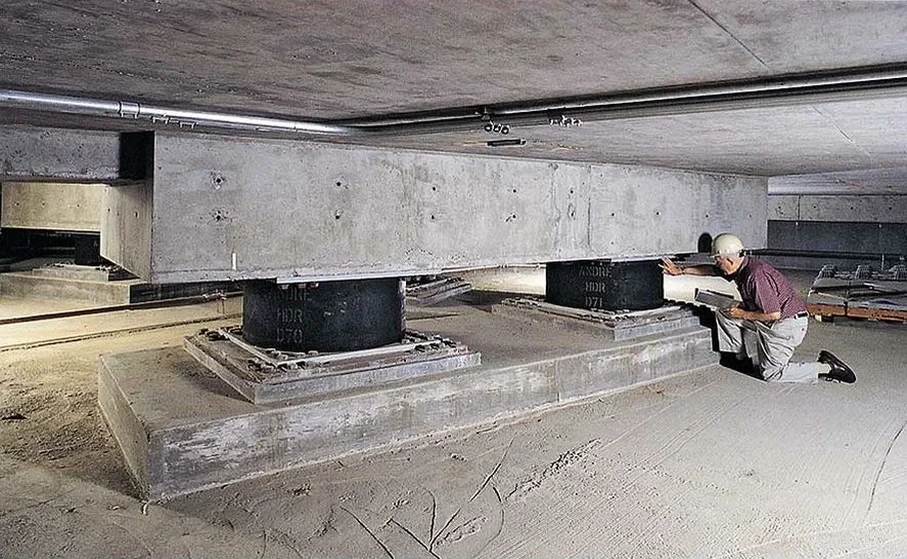
One practical observation from working in the New Orleans area is that the high groundwater table — often just 3 to 5 feet below grade — introduces a critical vulnerability at the isolation interface. The moat, required to permit lateral movement, becomes a direct pathway for water intrusion during a hurricane storm surge or a major flood event. If the drainage system for this moat is under-designed or relies on pumps that fail during a power outage, the isolators can become submerged. This not only accelerates corrosion of the bearing plates but also introduces hydrodynamic forces not accounted for in the seismic analysis. Our detailing always includes passive drainage, waterproofed moat walls, and corrosion protection packages based on the ASTM D2487 soil classification of the backfill, as the local organic silts are particularly aggressive to steel in a saturated environment.
Our services
Our base isolation design services for New Orleans projects are structured to take a project from concept through construction oversight, always grounded in the site-specific realities of the Gulf Coast.
Nonlinear Time-History Analysis
We develop full 3D structural models incorporating isolator nonlinearity and site-specific ground motions spectrally matched to the ASCE 7-16 target spectrum for Site Class E and F soils typical of New Orleans.
Isolator Specification and Prototype Testing Protocol
We prepare performance-based specifications for elastomeric or sliding isolators and define the full-scale testing regime required by IBC Chapter 17, including aging, scrap, and low-temperature property verification.
Soil-Structure-Interaction (SSI) Assessment
Direct SSI modeling accounts for the kinematic and inertial interaction effects that are amplified by the deep, soft soil deposits of the Mississippi River delta.
Peer Review and Construction Support
We provide full documentation for independent peer review panels and conduct construction-phase shop drawing reviews and field inspections of isolator installation.
Questions and answers
How much does a base isolation design for a New Orleans building typically cost?
For a mid-rise essential facility in New Orleans, the engineering design and analysis package generally ranges from US$3,790 to US$7,970, depending on the complexity of the superstructure and the number of required ground motion pairs for the nonlinear time-history analysis.
Is base isolation effective on the very soft clays found in the New Orleans area?
Yes, but it requires careful tuning. The soft clays amplify motion at longer periods, so the isolation system must be designed with a period sufficiently beyond the site's fundamental period — typically above 3 seconds — and with damping exceeding 20% to control displacements without transmitting excessive force.
What types of isolators are most suitable for Gulf Coast conditions?
Lead-rubber bearings and high-damping rubber bearings are common due to their compactness and inherent damping. Friction pendulum systems are also used, but their performance requires verification for the potential rocking effects on highly compressible soils.
How do you address the flood risk to the isolation layer in New Orleans?
The moat wall design includes a passive gravity drainage system leading to a sump with dual backup pumps, and all exposed steel components are specified with a high-performance coating system tested for continuous immersion in brackish water.
Does base isolation eliminate the need for deep foundations in New Orleans?
No, it works in conjunction with the foundation system. The isolators are placed atop a rigid base, which is almost always supported by driven piles or drilled shafts that extend through the soft clays to denser bearing strata, as determined by the site investigation.