The Mississippi River has deposited layers upon layers of soft, compressible clay beneath New Orleans for thousands of years. Some areas see natural water tables barely 3 feet below the surface. That combination of saturated fine-grained soil and high organic content makes compaction control a non-negotiable step in any earthwork project here. We run the sand cone test because it gives us a direct measurement of in-place density — no extrapolation, no assumptions. When we verify compaction on a levee rehab near the Industrial Canal or a building pad in Lakeview, we need to know the soil is actually meeting spec. Not just on paper. The data from a test pit excavation often guides where we take our field density points, especially when soil layers change abruptly across the site.
In saturated New Orleans clays, hitting 95 percent modified Proctor is a real battle — one we fight with moisture conditioning and precise field verification.
Methodology applied in New Orleans
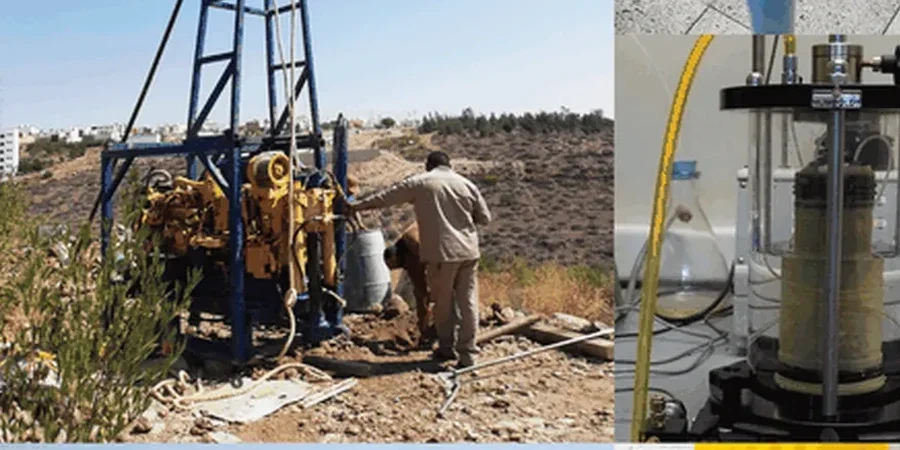
Typical technical challenges in New Orleans
Comparing a project in Metairie to one in the Lower Ninth Ward tells you everything about New Orleans soil variability. Metairie sits on older, slightly higher Pleistocene terraces with decent silt and sand layers. The Lower Ninth is built on recent Holocene swamp deposits — soft, dark, organic-rich clay that compresses under its own weight. If you skip field density verification in those swamp deposits, you can get differential settlement of several inches within the first year. We have seen pads where the contractor ran the roller the same number of passes everywhere, but the density still varied by 8 percentage points across 100 feet. That is why we take readings at the center and edges of each lift. The sand cone test catches those variations before the slab goes down. For deeper analysis of foundation behavior, we sometimes recommend a plate load test to confirm bearing capacity matches the compaction results.
Our services
Our compaction control approach in New Orleans covers the full workflow from lab reference to field verification. We handle the sampling, the Proctor curve development, and the in-place density measurement as one continuous quality assurance process.
Modified Proctor (ASTM D1557)
We establish the maximum dry density and optimum moisture curve using the 56,000 ft-lbf/ft³ compactive effort. This is the baseline for all field compaction acceptance in New Orleans structural fill.
Sand Cone Field Test
In-place density measurement using calibrated Ottawa sand. We test each lift — typically 8 to 12 inches loose thickness — and report compaction as a percentage of the lab maximum.
Nuclear Gauge Correlation
When projects use a nuclear density gauge for rapid readings, we run side-by-side sand cone tests to build a site-specific calibration curve. This satisfies ASTM D6938 correlation requirements.
Moisture-Density Report
We deliver a signed, stamped report with test locations plotted on the site plan, dry density, moisture content, compaction percentage, and pass/fail criteria per project specifications.
Questions and answers
What is the typical cost for a sand cone density test in the New Orleans area?
For projects within the greater New Orleans metro area, field density testing with the sand cone method typically runs between US$100 and US$150 per individual test point. That price includes the technician's time, the calibrated sand and equipment, the field moisture determination, and the written report. The total number of test points depends on the square footage, number of lifts, and the compaction spec — usually one test per 1,500 to 2,500 square feet per lift. We can give you a firm per-point rate once we review the earthwork sequence.
How long does a sand cone test take on site?
One test point takes about 15 to 20 minutes from setup to backfill. We excavate the hole carefully to avoid disturbing the sidewalls. Then we weigh the extracted soil, run the sand through the cone, and collect a sample for moisture content. The moisture determination takes additional time — we either use a field stove or bring the sample back to the lab for oven drying. You can expect results the same day for the density number, and a formal report within 24 hours.
Can you run a sand cone test in wet or saturated New Orleans soils?
The reference range for this service in New Orleans is US$100 - US$150. The final price depends on the project scope and volume.
What is the difference between standard Proctor and modified Proctor compaction?
The difference is compactive effort. Standard Proctor uses a 5.5-pound hammer dropped 12 inches — 12,400 ft-lbf/ft³. Modified Proctor uses a 10-pound hammer dropped 18 inches — 56,000 ft-lbf/ft³, about 4.5 times more energy. Nearly every structural fill specification in New Orleans calls for modified Proctor, typically at 95 percent of the maximum dry density. The modified test better approximates the compaction modern heavy rollers actually achieve in the field.