Deep excavation in New Orleans demands protocols beyond standard practice because the city sits up to 6 feet below sea level on Holocene deltaic deposits. The ASCE 7 load combinations and IBC Chapter 18 requirements are not checklists here; they are survival parameters when cutting through compressible clays that can lose strength under rapid drawdown. Pore pressure response in the upper 30 feet often governs wall selection, and the interaction between sheet-pile deflection and adjacent shallow footings requires soil-structure modeling that accounts for creep in organic silts. A CPT test provides the continuous stratigraphy needed to calibrate those models, while retaining walls tie-back design must factor in the 100-year flood elevation and the resulting unbalanced hydrostatic head. Without that integration, even a well-braced cut can heave before the mat pour is complete.
Base stability in New Orleans is a race between excavation rate and pore pressure dissipation in the deposit below.
Methodology applied in New Orleans
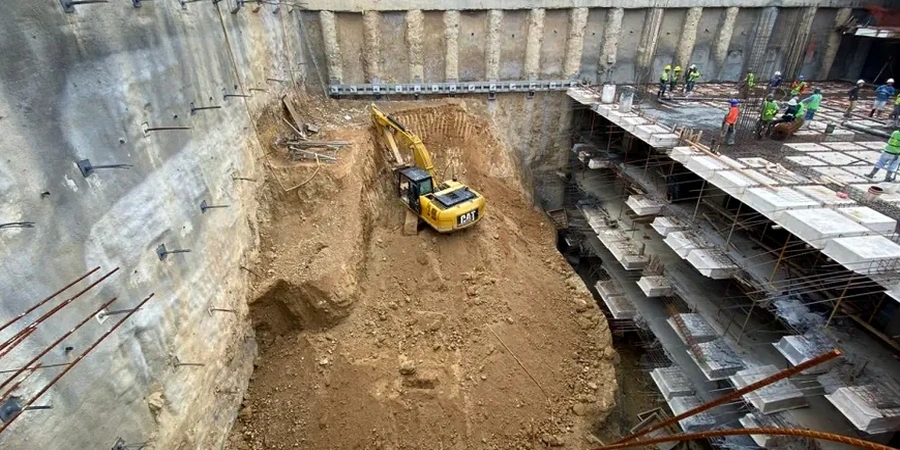
Typical technical challenges in New Orleans
The subtropical humidity of south Louisiana accelerates corrosion loss in steel bracing while seasonal Mississippi River stages swing the phreatic surface by 10 feet or more in a matter of weeks. An excavation designed for low-water conditions in October may face near-surface saturation in April, reducing passive resistance and inviting basal heave. The local practice of driving sheet piles through desiccated crust into soft fat clay creates a hydraulic window if the interlocks unclutch during driving, and that leakage can erode the passive wedge silently. Our risk register for each project weighs storm-surge timing against construction schedule, assigns probability to interlock separation based on driving records, and recommends redundancy in the dewatering system so that a single pump failure does not flood the cut. We also specify standpipe piezometers at multiple depths to verify that the actual pore pressure profile matches the design assumption before each lift of excavation proceeds.
Our services
Our excavation design services in New Orleans cover the full cycle from feasibility to construction support, always tied to the specific subsurface conditions of the Mississippi Delta.
Staged Excavation Analysis
Finite-element modeling of sequential cut stages with explicit pore pressure coupling, calibrated to site-specific CPTu and laboratory consolidation data. Outputs include wall bending moments, strut loads, and surface settlement contours.
Dewatering and Base Stability Design
Groundwater control system sizing using MODFLOW-based drawdown simulation and Terzaghi-Bjerrum base stability checks. We design well-point spacing, filter gradation, and sump capacity for the projected river stage during the construction window.
Questions and answers
What is the typical cost range for geotechnical design of a deep excavation in New Orleans?
Deep excavation design for New Orleans projects typically falls between US$1,910 and US$7,460, depending on cut depth, wall type, and the required level of staged finite-element analysis. Shallow cuts under 20 feet with simple bracing land at the lower end, while deeper urban excavations near existing structures requiring time-history groundwater modeling reach the upper range.
How does the high water table affect deep excavation design in New Orleans?
The water table in New Orleans is often less than 5 feet below grade, which means almost every cut below basement level requires active dewatering. Design must account for the unbalanced hydrostatic pressure on the wall, the risk of piping at the toe, and the reduction in passive resistance once the soil is saturated. We model steady-state seepage and transient drawdown to confirm that the specified well system can maintain a dry subgrade throughout excavation.
Which soil parameters are most critical for excavation analysis in the Mississippi Delta?
Undrained shear strength profiles from in-situ vane and CPTu tests are the primary input, along with the overconsolidation ratio derived from laboratory oedometer tests. The organic content and plasticity index, obtained from Atterberg limits and loss-on-ignition, determine whether creep or strain-softening must be included in the numerical model. These parameters directly control predicted wall deflection and surface settlement.