New Orleans grew along the natural levees of the Mississippi, but the deeper you go into the former cypress swamps of Mid-City and Gentilly, the more the soil profile turns unpredictable. The city sits atop a 200-foot-thick sequence of Holocene deltaic deposits where interbedded soft clays, organic silts, and peat layers shift laterally over just a few hundred feet. Standard SPT blow counts often blur these transitions, which is why our team runs the CPT rig through the upper 60 to 100 feet of the profile. We measure tip resistance, sleeve friction, and dynamic pore pressure simultaneously, catching thin compressible seams that a split-spoon sampler would miss. Before laying out a pile-supported structure in the French Quarter or a floodwall alignment in the Lower Ninth Ward, understanding the undrained shear strength profile with continuous data helps avoid differential settlement surprises. For deeper liquefaction screening, the CPT data feeds into the liquefaction triggering analysis required by the IBC when the groundwater table sits within 3 feet of grade.
Continuous CPT profiling in the Mississippi delta captures sensitive clay seams that standard blow counts overlook, and those seams dictate settlement behavior.
Methodology applied in New Orleans
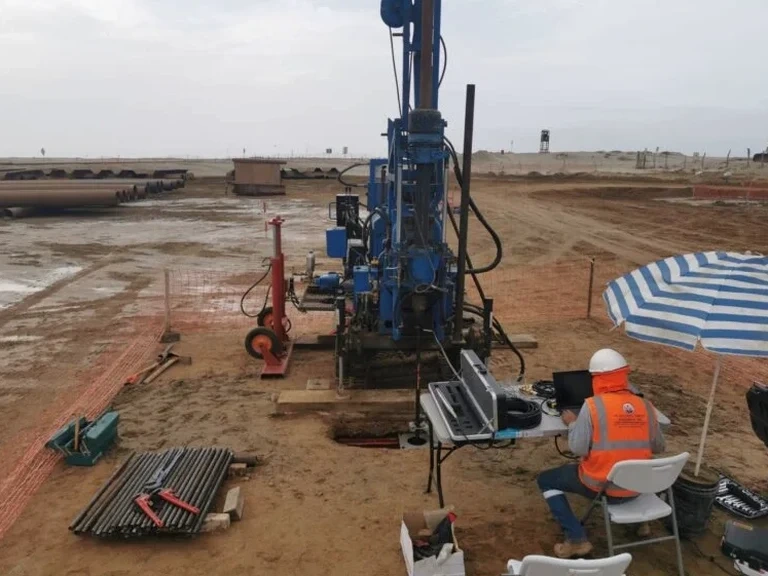
Live process video
Typical technical challenges in New Orleans
The soil contrast between the Garden District and New Orleans East is dramatic. The Garden District sits on the Metairie-Gentilly ridge, where Pleistocene silty clays offer moderate strength and fast drainage. Move east past the Industrial Canal, and you are into Holocene marsh deposits with undrained shear strengths that can drop below 200 psf at 20 feet. A CPT sounding in the East often reveals a sharp pore pressure spike just below the desiccated crust, followed by a clay layer so sensitive that remolding during pile driving would erase most of its strength. If the tip resistance stays under 5 tsf while friction ratios exceed 4 percent, the risk of excessive settlement under embankment loads is real. Our engineers flag these zones immediately, because ignoring them leads to post-construction settlements of 6 to 12 inches over a decade, which no amount of slab reinforcement fixes.
Our services
Our CPT program in the New Orleans metro area goes beyond pushing a cone and printing a log. We integrate the soundings into a broader geotechnical investigation that answers the questions structural and civil engineers actually ask.
Piezocone with Pore Pressure Dissipation
We run the CPTu with a saturated ceramic element behind the cone shoulder, measuring u2 during penetration and then pausing at target clay layers to record the time to 50 percent dissipation. In the low-permeability clays of Lakeview and Gentilly, these dissipation tests directly estimate the coefficient of consolidation, which controls the rate of settlement under levee and tank loads.
Seismic CPT for Shear Wave Velocity
For site class determination per IBC Table 1613.2.3, we deploy a seismic cone with an internal geophone at 1-meter intervals. A shear beam at the surface generates a wave, and the interval travel time gives us Vs profiles that feed site-specific ground motion analyses. This is particularly useful where the Pleistocene surface dips below 100 feet and the site class boundary between D and E becomes ambiguous.
Questions and answers
What does a CPT cost in New Orleans, and what drives the price?
A standard CPT sounding to 60–80 feet in the New Orleans area typically runs between US$140 and US$220 per linear foot, mobilized. The final figure depends on access — tight Quarter lots with low overhead clearances require a smaller push rig — and whether dissipation tests or seismic cone add-ons are required. Multiple soundings in one mobilization bring the unit rate down.
How does the CPT handle the dense sand layers near the river?
Our 20-ton push rig can penetrate dense sand stringers with tip resistances exceeding 200 tsf, but when we encounter thick Pleistocene sand bodies below 80 feet, we pre-drill through the stiffest cap or switch to rotary wash techniques to protect the cone. The friction ratio and pore pressure response tell us when we have crossed into a sand unit.
Can CPT results be used directly for pile design in the Mississippi delta?
Yes, and it is standard practice. We use the LCPC method and the more recent UWA-05 and Fugro-05 design approaches for driven piles, correlating tip resistance and sleeve friction to unit shaft and end bearing values. For the soft clays of New Orleans East, the CPT-based undrained shear strength profile is essential for calculating downdrag and negative skin friction from consolidating layers.
How long does a CPT sounding take on a typical job?
A single 80-foot penetration with continuous data takes roughly 45 to 60 minutes of push time. Add another 30 to 90 minutes per dissipation test depending on soil permeability. With setup, breakdown, and moving between locations, we complete three to four soundings on a standard field day.
Is the CPT accepted by the Orleans Parish permitting office?
Absolutely. The City of New Orleans Department of Safety and Permits and the Sewerage & Water Board both accept CPT data as primary geotechnical information, provided the report follows ASTM D5778 and includes the engineer’s interpretation of soil behavior type, strength parameters, and liquefaction screening in accordance with the current IBC.