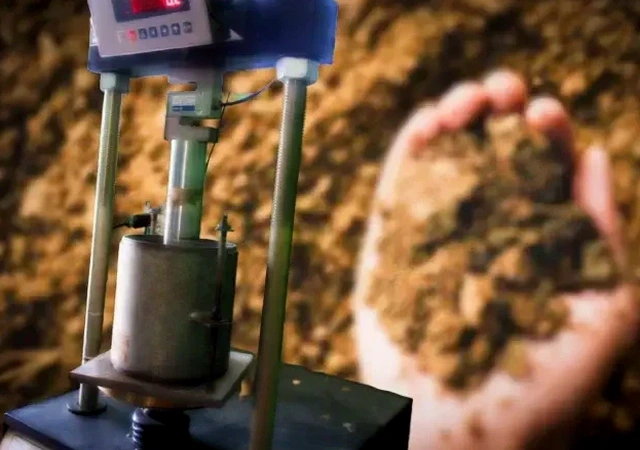
The single biggest mistake we see in New Orleans pavement design is using a textbook CBR value instead of a real lab result. A contractor grabs a number from an old table, designs the asphalt section, and eighteen months later the road is alligator-cracked from the first wet season. Soft alluvial clays and silts dominate the Mississippi River delta, and their strength drops dramatically when saturated. Our laboratory CBR test gives you the soaked bearing ratio the subgrade will actually have after a heavy rain or a hurricane surge. Without it, you are guessing on stone base thickness, and in New Orleans that guess gets expensive fast. We run the procedure strictly under ASTM D1883, compacting remolded samples at field moisture and density, then soaking them for 96 hours before the piston penetrates at 0.05 inches per minute. The result is a single number that feeds directly into your AASHTO 1993 pavement design or the local DOTD specifications. For projects near Lake Pontchartrain or in the Ninth Ward, where groundwater sits barely two feet down, we often pair the lab CBR with an in-situ permeability test to understand how fast the subgrade saturates after a storm.
A soaked CBR of 2 percent is not a lab error in New Orleans. It is the reality of designing roads on saturated delta clay.
Methodology applied in New Orleans
Typical technical challenges in New Orleans
New Orleans grew by draining swamps, which caused the organic soils to oxidize and subside. Entire neighborhoods now sit several feet below sea level, and the subgrade beneath the streets is a mix of recent alluvium, artificial fill, and buried marsh deposits. This geology makes pavement design uniquely unforgiving. A CBR test run on a dry sample in July will give a deceptively high number, maybe 8 or 10 percent. But that same soil, after a three-day rain event like we saw during Hurricane Isaac, will drop below 3 percent. The risk is not just cracking. It is complete base course failure when the saturated subgrade pumps up through the stone under traffic loads. We have pulled cores from failed streets in Gentilly where the aggregate had literally disappeared into the clay. The lab CBR, properly soaked, predicts that failure before the first truck rolls. For deep soft soil profiles where the pavement structure alone cannot bridge the weak layer, we often discuss stone columns or vibrocompaction as ground improvement options before placing the pavement section.
Our services
Our laboratory CBR program in New Orleans covers the full workflow from sample receipt to pavement design input. We do not just run the piston test and hand you a number. We prepare the sample correctly, run the companion Proctor, and interpret the results in the context of local subgrade behavior.
Standard Soaked CBR (ASTM D1883)
Three-point compaction curve plus CBR test on samples soaked for 96 hours. Includes swell measurement during soaking and corrected CBR values at 0.1 in and 0.2 in penetration. Delivered with the load-penetration curve and the compaction report.
CBR vs. Moisture Sensitivity Package
CBR tests run at optimum moisture, optimum plus 2 percent, and optimum minus 2 percent. Shows the sensitivity of bearing strength to field moisture variation. Critical for New Orleans projects where construction dewatering is difficult and subgrade moisture fluctuates.
Pavement Section Verification Report
Using the measured CBR value, we calculate the required asphalt and base course thickness per AASHTO 1993 and check against LADOTD standard details. The report includes a comparison with the design section and a recommendation for any adjustments.
Questions and answers
What does a CBR test cost in New Orleans?
A standard laboratory CBR test on one sample, including the modified Proctor compaction curve and the 96-hour soak, runs between US$130 and US$190. The price depends on whether we are testing one moisture point or three. A full sensitivity package with three CBR points at different moisture contents will be at the upper end of that range. Turnaround is typically 7 to 10 business days accounting for the soaking period.
Why do you soak the sample for 96 hours?
ASTM D1883 requires a minimum soaking period to simulate the worst-case saturated condition the subgrade will experience during the pavement's life. In New Orleans, where the groundwater table is high and stormwater ponds on the surface, the soaked condition is the design condition. A shorter soak gives an unconservative CBR value that leads to under-designed pavement sections.
What CBR value should I expect for a New Orleans subgrade?
For the fat clays and silty clays common in the New Orleans metro area, soaked CBR values typically range from 1 to 4 percent. Sandy or silty soils from the natural levees along the Mississippi River can reach 6 to 10 percent. If your subgrade is an artificial fill with crushed concrete or stone, values above 15 percent are possible, but we still recommend testing because fill quality varies widely across the city.
How many CBR samples should I take for a project?
For a street reconstruction or small parking lot, one sample per distinct soil type is usually sufficient. For a larger project like a subdivision or a port facility, we recommend at least one CBR test per 2,000 square yards of pavement area, with additional samples wherever the subgrade material changes visually or by feel. The LADOTD standard specifications provide minimum testing frequencies that we follow as a baseline.